
You found a Goyard bag on a resale platform. The price looks right – maybe even slightly too right. The seller has photos, a description, maybe even a dust bag. Now you’re trying to figure out if it’s actually real before you transfer four figures to a stranger on the internet. Good instinct.
Knowing how to tell a fake Goyard from a real one matters more than it used to. Counterfeits have gotten significantly better in the last few years. The obvious fakes – the ones with blurry canvas and plastic-smelling leather – are easy. It’s the “super fakes” that are harder, and they’re what most buyers actually encounter on the secondhand market. These checks are specific to Goyard. For the general, cross brand version covering stitching, hardware, and packaging, see my guide on how to spot a fake designer bag. If it’s the leather itself you’re unsure about rather than the brand specific details, I break down the texture, label, smell, and price tests in my guide to telling real leather from fake. This guide cuts straight to the checks that still catch them, in order of how fast you can run each one.
Start Here: The Two-Second Check Most People Skip
Before you examine a single detail, do this: pick the bag up and feel the canvas. Run your fingers across the surface of the Goyardine. On a real Goyard, the hand-painted chevron pattern has a slightly raised, tactile texture – you can feel the individual layers of paint. It’s subtle, but it’s there. Fakes almost always feel flat and smooth because the pattern is machine-printed directly onto the fabric rather than applied in layers by hand.
If the canvas feels flat, you can stop there. You’re looking at a fake.
If it passes that first test, move on to the seven checks below. They’re ordered from fastest to most detail-intensive – run them in sequence and stop when you find a problem.
1. The Chevron Pattern – Connected Ys Are Non-Negotiable
The most reliable single check on any Goyard piece – bag, wallet, or card holder – is whether the Y shapes in the chevron pattern connect to each other. On every authentic Goyard, the Ys touch. Not almost touch. Actually connect, with the dots of one Y sitting right up against the next. If there’s a visible gap between them, even a small one, it’s a fake.
This is the check that catches the most counterfeits, including decent-quality ones. Replicating the exact spacing of the hand-painted Goyardine pattern is extremely difficult to do at scale, and counterfeiters consistently get it slightly wrong. The dots should also be small, uneven, and slightly slanted – not perfectly uniform. If the dots look too regular, too symmetrical, or too neatly spaced, that’s a red flag even if the Ys are technically connected.
Colour saturation matters here too. On a fake Goyard, the canvas tends to look more dull and less vibrant than the real thing, and the parts of the pattern that should appear gold often look brown instead. Hold the bag near natural light if you can – the difference in colour depth is much easier to see outside than under artificial lighting.
2. The Heat Stamp – Font Weight Tells the Story
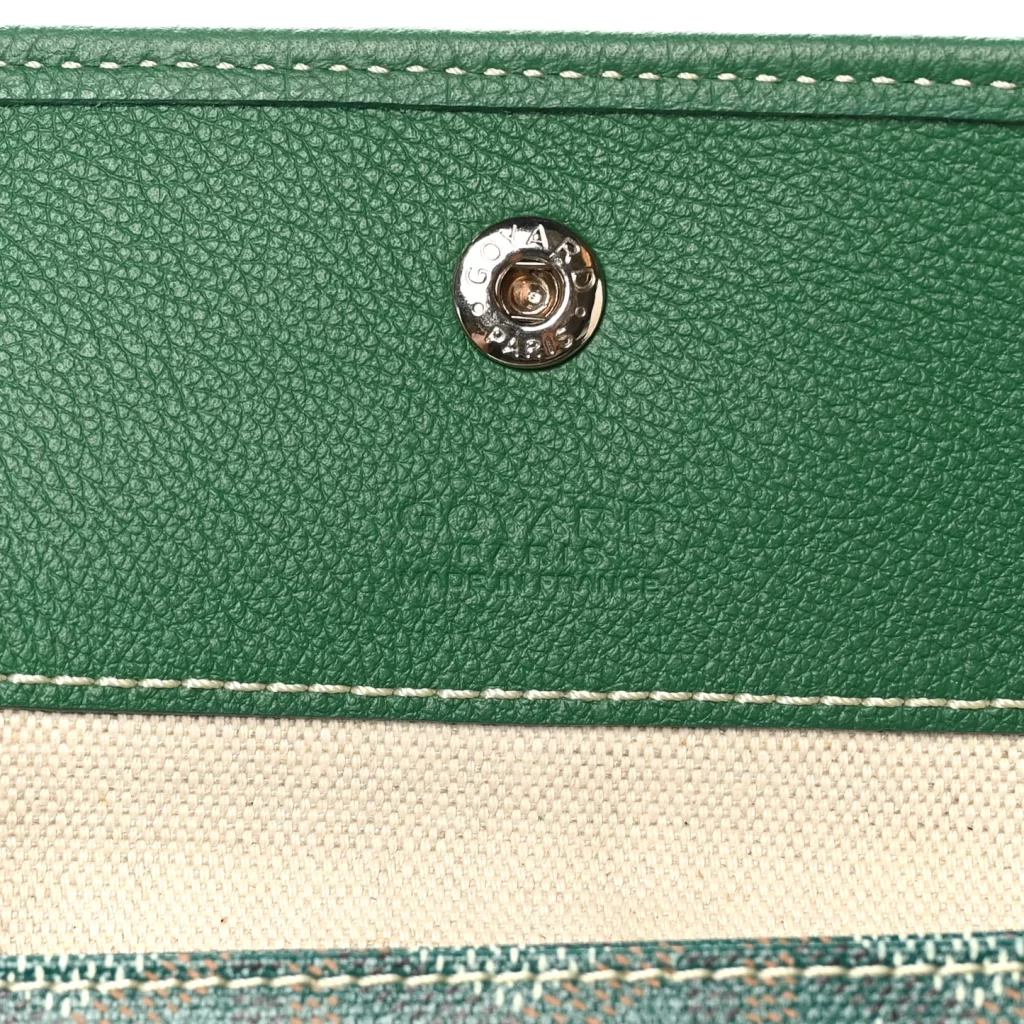
Flip the bag and find the heat stamp. On authentic Goyard bags it reads “GOYARD PARIS MADE IN FRANCE” and it should be clean, sharp, and stamped into the leather – not raised above it, not painted on. The font is distinctive and the quality of the stamp reflects the overall craftsmanship of the bag.
Here’s what to check specifically: the word “GOYARD” should be in relatively thick letterforms, while “HONORE” and “PARIS” below it should be noticeably thinner. Fakes consistently get this backwards – the “GOYARD” text comes out too thin and the secondary text comes out too thick. On the fake Saint Louis, the “GOYARD” text is too thin compared to the real one, while the “HONORE” and “PARIS” inscriptions appear too thick.
Also check the “H” in “HONORE” – it should be clearly defined with straight vertical strokes. On fake card holders and wallets, the H often looks more like an N, which is a very specific tell that crops up repeatedly across counterfeit Goyard pieces.
The “MADE IN FRANCE” line should sit centred between the handles on the leather edge in a thin, sharp, sans-serif font with no bleeding or blurring at the edges.
(Image credit: FashionPhile)
3. The Date Code – Thin Characters, Easy to Read
Every authentic Goyard bag has a date code – typically three letters followed by six digits, stamped on a leather tab inside the bag. Authentic Goyard bags have a date code with thinner and less deep characters that are clear and legible, unlike the harder-to-read characters that are embossed more deeply into the leather on fakes.
That’s the counterintuitive part: the real date code looks more delicate than the fake one. Counterfeiters tend to overdo the embossing because they assume deeper and bolder equals more premium. It doesn’t. The genuine stamp is precise and legible but light-handed. If the date code looks heavily pressed, chunky, or difficult to read because the characters are too deep – that’s a fake tell, not a quality signal.
Location varies by model and production year. On older Saint Louis totes, look inside the interior pocket. On newer versions, the date code sits on the leather strap that connects the detachable pouch to the bag. On wallets and card holders, it’s usually inside the front pocket at the side seam.
4. The Handles – Weight, Stitching, and Shape
The handles on a real Goyard Saint Louis tote are thicker than most people expect, and the stitching is tight and boxy in appearance. On fake bags, the handles tend to be wider but thinner, with weaker stitches that could break more easily.
Run your finger along the stitching on the handles. On an authentic bag, the thread is consistent in tension, evenly spaced, and sits flush rather than puckering. On fakes, the stitching is often the first place quality control breaks down – threads that are too long, too thin, or irregularly tensioned appear even on high-quality counterfeits.
In one authentication example, the straps on a fake Saint Louis were severely warped – not from wear but from a rushed, unprofessional manufacturing job, and the stitch work was inconsistent compared to a genuine bag. Handle warping straight out of purchase is a near-certain fake indicator. Authentic Goyard handles may darken and patina with use, but they don’t warp.
Also check how the handles attach to the bag body. The connection points should be reinforced and clean. If the leather looks stretched around the attachment points, or the stitching there is inconsistent with the rest of the bag, walk away.
5. The Hardware – Shine Without Going Overboard
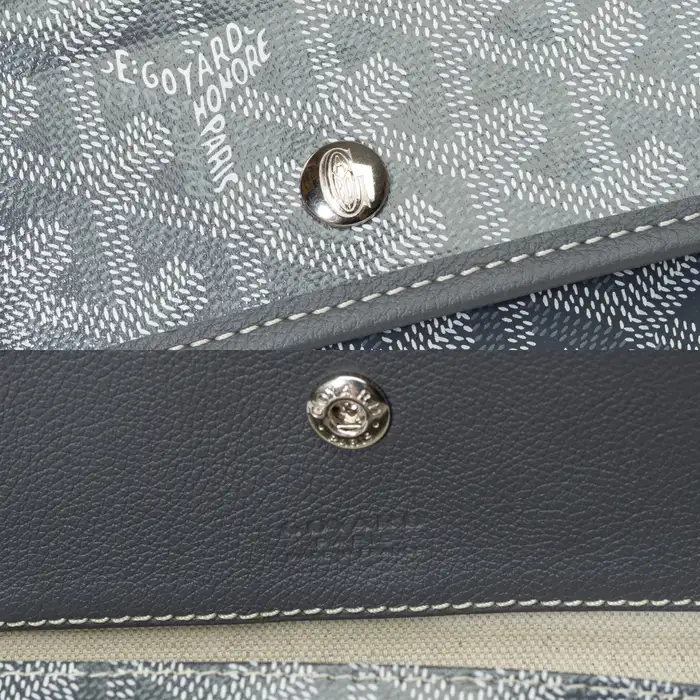
Authentic Goyard hardware – buckles, D-rings, the G button on the Saint Louis pouch – sits in a specific range of reflectivity. The real button is shinier and reflects light more clearly than the fake, while the D-ring on counterfeits tends to be too shiny, reflecting too much light. This sounds like a fine distinction and it is, but once you’ve seen it you can’t unsee it.
The G logo on the silver button of the Saint Louis pouch should be clearly legible with closely-spaced, deeply-etched lettering. The fake pouch button tends to be a different shape – smaller, with a logo that isn’t prominent enough and lettering that looks almost scratched off rather than properly engraved.
Fake hardware also tends to tarnish faster and feel lighter in hand. If you can press the clasps or buckles – do. Real hardware has a satisfying, solid weight to it. Flimsy or hollow-feeling metal is a red flag regardless of how the rest of the bag looks.
(Image credit: 1stDibs)
6. The Interior Lining – Mustard Yellow and Cotton Twill
Open the bag. The interior lining of an authentic Goyard Saint Louis is a high-quality cotton twill in a distinctive mustard yellow. It’s a specific, warm shade – not bright yellow, not beige, but a rich golden mustard. This lining colour is considered a Goyard signature and it’s one of the most consistent details across authentic pieces.
Fakes regularly get the lining colour wrong. It often comes out too pale, too bright, or slightly greenish compared to the real thing. The texture matters too – cotton twill has a visible weave pattern and a slightly substantial feel. If the lining feels thin, slippery, or synthetic, it’s not right.
The lining of an authentic St. Louis tote is a high-quality cotton twill – many bags feature a striking mustard yellow colour that is considered a Goyard signature. The pouch that comes with the Saint Louis has its own interior – check that too. The pouch lining on a real bag will match the main bag’s quality and colour. On fakes, the pouch is often where corners get cut most visibly.
7. The Dimensions and Weight – Counterintuitive but Reliable
This one surprises people: an authentic Goyard Saint Louis tote is lighter than most fakes, not heavier. The Goyardine canvas is lightweight by design – it’s one of the bag’s functional selling points. An authentic St. Louis tote will actually feel lighter than a fake, even though the fabric is clearly higher quality.
If a bag feels heavy and stiff before you’ve put anything in it, that’s a signal the materials aren’t right – counterfeiters often use denser, heavier canvas substitutes that don’t replicate the weight profile of the real thing.
Dimensions are worth checking too, particularly if you’re buying a wallet or card holder. Counterfeiters often use pictures as a reference rather than the real product, which means their dimensions and ratios can be subtly off compared to the authentic piece. A Goyard card holder that looks slightly wider, taller, or thicker than reference images is worth scrutinising carefully before assuming everything else is fine.
A Note on Goyard Wallets and Card Holders
Everything above applies to wallets and card holders as well as bags, but there are a few wallet-specific checks worth knowing.
On card holders like the Saint Sulpice, the Y pattern check is the fastest tell – if the Y symbols are not touching and connecting to each other, that’s a near-certain indicator of a fake. The “H” in HONORE is another reliable wallet check: well-defined on the real piece, often distorted into something resembling an N on fakes.
The interior of a genuine Goyard wallet has leather on at least one side of the bill compartment. Fake wallets frequently use linen fabric throughout the interior where the real version has leather – the bill compartment on an authentic piece has leather on one side, while fakes use linen fabric instead.
Authentic Goyard wallets and card holders also come with a soft cotton dust cloth – not synthetic, not felt. If what’s in the box feels cheap or slightly plasticky, the wallet it came with likely is too.
What to Do If You’re Still Not Sure
If the bag passes most of these checks but something still feels off, trust that feeling. Super fakes are designed to pass casual inspection. The details that give them away are often subtle enough that even experienced buyers occasionally miss one or two.
Your options at that point: send detailed photos to a professional authentication service (LegitGrails, Real Authentication, and Authenticate First all offer this) or take the piece to the nearest Goyard boutique. Goyard’s in-store staff can authenticate pieces, though it’s worth noting this is a courtesy rather than a guaranteed service at every location.
For resale purchases, buying from established platforms with authentication guarantees – Fashionphile, Vestiaire Collective’s authenticated listings, or The RealReal – adds a layer of protection even before you start checking details yourself.
For more on buying Goyard at the right price, see our complete guide to Goyard prices, history, and value.
Frequently Asked Questions
How can you tell if a Goyard bag is real?
Start with the Goyardine canvas texture – it should feel slightly raised from the hand-painted pattern layers, not flat or smooth. Then check that the Y shapes in the chevron pattern connect to each other with no gaps. Those two checks alone will catch the majority of fakes. If both pass, move to the heat stamp font weight and date code quality for a more thorough check.
What is the easiest way to spot a fake Goyard Saint Louis?
The connected Y pattern is the single fastest check. On every authentic Saint Louis, the Ys in the Goyardine chevron touch and connect. If you can see clear spacing between them, you’re looking at a fake. Second easiest is the interior lining – it should be a specific mustard yellow cotton twill, not pale, synthetic, or greenish in tone.
How do I authenticate a Goyard wallet or card holder?
Same Y-pattern check applies – the pattern should connect across the entire surface. Then check the heat stamp legibility and font weight, the clarity of the “H” in HONORE (not an N shape), and the interior material. Real Goyard wallets have leather on at least one side of the bill compartment – fakes often use fabric throughout.
Are Goyard fakes easy to spot?
Basic fakes, yes. Super fakes – the higher-quality counterfeits that have become more common in recent years – require more careful inspection, particularly around date codes, handle construction, and canvas texture. None of the checks in this guide require special equipment, but they do require looking closely and knowing what you’re looking for rather than doing a quick once-over.
Can Goyard authenticate a bag for you?
Goyard boutiques can informally verify pieces, though this is a courtesy service rather than a formal authentication process. Staff in-store are knowledgeable about their own product and will generally flag obvious fakes. For resale purchases where authenticity is genuinely in question, a dedicated third-party authentication service is a more reliable route.
The Short Version
Fake Goyard bags have gotten better. The days of spotting one from across the room by its plasticky sheen are mostly behind us. But the fundamentals haven’t changed: the connected Y pattern, the heat stamp font weights, the mustard yellow lining, the lightweight canvas, the precisely stamped date code. Fakes consistently fail on at least one of these, usually more.
Run the checks in order, trust what you feel as much as what you see, and don’t let a low price talk you out of what your hands are telling you.
If you’re considering your first Goyard purchase and want to understand the full picture before you buy – pricing, resale value, which styles are worth it – our complete Goyard guide covers everything.