I bookmarked a cruelty free brand list back in 2019, the kind with a giant spreadsheet of yeses and nos, and Dove sat firmly in the no column. So when I started rebuilding my shower shelf around cruelty free brands last month and reached for my Dove body wash out of habit, I froze. I went looking for the receipt on that old no, expecting to confirm it in five minutes and move on. Instead I spent close to three weeks going through PETA’s database, Dove’s own policy pages, and a stack of independent trackers, and the answer that came back wasn’t the one I’d bookmarked. Here’s the short version, since you’re probably here for it: yes, Dove is currently cruelty free by the two major watchdogs that actually matter. Here’s everything that answer is missing, plus the one ingredient detail that genuinely surprised me.
The Quick Answer: Is Dove Cruelty Free?
Yes. Dove is PETA approved and appears on PETA’s Beauty Without Bunnies list, meaning the brand states that neither its finished products nor its ingredients are tested on animals, and that its suppliers and third parties follow the same rule. Independent trackers I checked against PETA’s listing, including Cruelty Free Kitty, land on the same conclusion for 2026.
That yes comes with three asterisks worth knowing before you restock your bathroom: Dove isn’t Leaping Bunny certified, it isn’t a fully vegan brand, and its parent company Unilever is not cruelty free as a whole. None of those asterisks cancel out the yes. They just mean the full picture takes more than one sentence, so let’s actually go through it.
What PETA’s Approval Actually Confirms
PETA doesn’t just publish an opinion about a brand. Getting listed on PETA’s cruelty free database requires a company to sign a statement of assurance confirming that no animal testing happens anywhere in its supply chain, not by the company itself, not by suppliers, and not by a third party acting on its behalf. Dove has signed that statement, and PETA’s listing states plainly that neither Dove nor its suppliers or third parties test on animals.
I want to be honest about what surprised me here, because it’s the opposite of what usually happens when I check a mass market brand. Most of the drugstore names I’ve dug into for this site, the ones sold at the same shelf as Dove, get disqualified the moment they sell into mainland China, since regulators there have historically required animal testing on imported cosmetics before approval. I assumed Dove would follow the same pattern. It doesn’t, and the reason is specific enough that I don’t think most of the older blacklists ever accounted for it.
The China Question: Why Dove Reads Differently Than Nivea or La Roche Posay
This is the part that actually explains why my 2019 bookmark and PETA’s current listing disagree. Dove does sell in mainland China. What changed is how. Dove manufactures its China market products domestically and registers them as general cosmetics rather than the special category that historically triggered mandatory animal testing for imported goods. Selling that way, only online in some cases and always without the imported special use classification, is what let Dove avoid the requirement that still trips up brands like Nivea and La Roche Posay.
I looked into La Roche Posay’s cruelty free status for this site a while back, and the difference is instructive. La Roche Posay’s own policy includes a carve out for testing “where required by law,” and the brand hasn’t restructured its China sales to avoid that requirement the way Dove has. That single operational choice, selling as general cosmetics manufactured locally instead of imported specialty products, is the entire reason Dove clears a bar that a lot of comparably sized brands don’t. It’s not a loophole exactly. It’s a brand actually changing how it does business to keep the claim honest, which is more than I expected to find when I started this.
Since When Is Dove Actually Cruelty Free?
Dove states it has not tested or commissioned testing on any ingredient in its products since 2010, which puts the policy more than two years ahead of the EU’s own cosmetics testing ban. The China manufacturing shift came later and is the piece that actually resolved the gap between Dove’s stated policy and its real world practice. If you saved a list from 2019 or earlier that flagged Dove as a no, that list was written before the China question got settled the way it has now, which is exactly the trap I fell into.
Why Dove Isn’t Leaping Bunny Certified
Here’s where the yes gets its first real asterisk. Leaping Bunny is generally considered the stricter of the two major certifications, since it requires annual renewal, supplier audits, and an ongoing monitoring system rather than a one time signed statement. Dove has never pursued that certification, and as far as I can tell from Leaping Bunny’s own public database, it isn’t currently listed there.
I used to treat a missing Leaping Bunny logo as a soft red flag before I understood what actually separates the two programs. A brand the size of Dove, selling in over 190 countries, could almost certainly afford the audit process if it wanted to. Not pursuing it doesn’t mean something’s being hidden. It just means you’re relying on PETA’s standard specifically for this one, which is a real ongoing program, just a less exhaustive one than Leaping Bunny’s supply chain audits.
Is Dove Vegan Too? This Is Where I Got Tripped Up
Cruelty free and vegan measure two completely different things, and I know I’m not the only person who’s confused them. Cruelty free means nothing was tested on animals. Vegan means the formula itself skips animal derived ingredients entirely. A product can pass one standard and fail the other, and Dove is a clean example of exactly that gap.
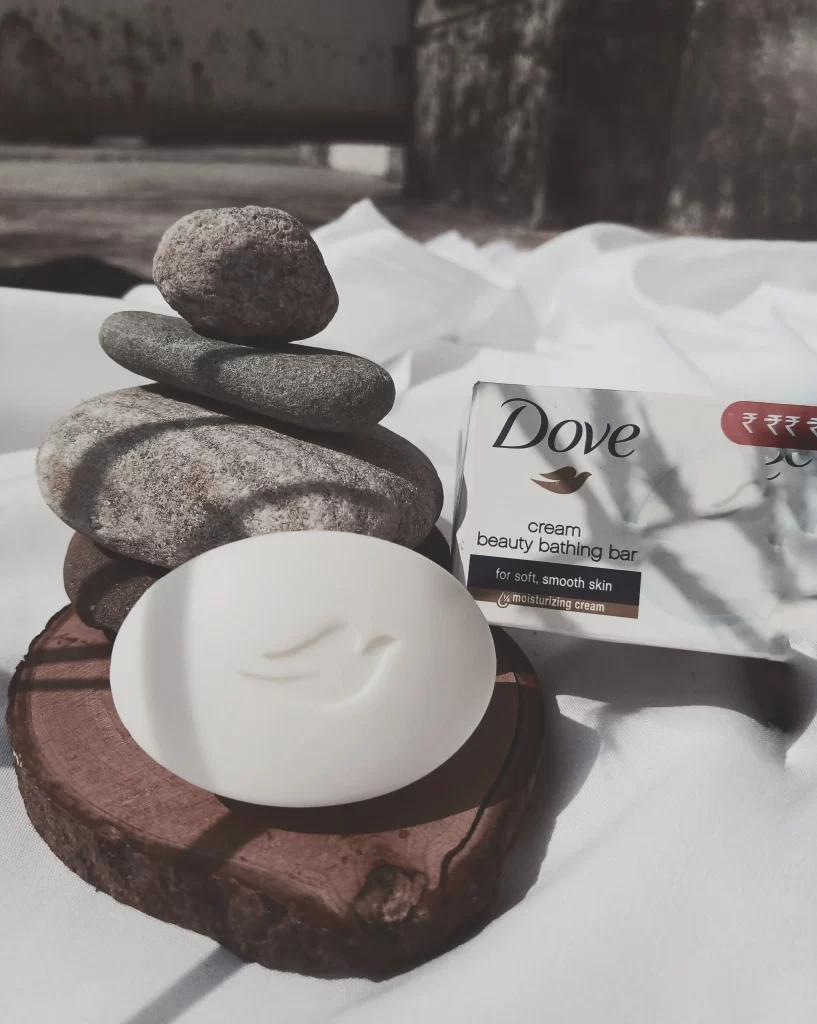
Here’s the part that actually surprised me during my research. I pulled the ingredient list on a Dove Original bar and found sodium tallowate near the top, an animal fat derived cleansing agent typically rendered from beef or mutton, not pork. Some Dove bar formulations list “sodium tallowate or sodium palmitate,” meaning the plant based version shows up depending on the specific bar and region, but you can’t assume every white bar on the shelf is the vegetable oil version without checking that exact package. If halal or vegan sourcing matters to you specifically, this is the detail to check on the bar in your hand, not the brand’s general reputation. Dove’s liquid body washes tend to skip tallow entirely in favor of plant derived surfactants, so the concern is really concentrated in the classic bar soap line, not the whole catalog.
Who Owns Dove, and Does That Matter?
Dove is owned by Unilever, the Anglo Dutch consumer goods company formed in 1930, and Unilever as a whole is not classified as cruelty free by PETA or Leaping Bunny. This is the pattern I’ve run into with almost every mass market brand I’ve checked for this site: a genuinely compliant brand sitting inside a much larger portfolio that isn’t uniformly clean.
My honest take, and I know this puts me at odds with some of the stricter corners of the cruelty free community, is that I don’t think the parent company question should override a brand’s own documented, audited behavior. Dove restructured how it sells into China specifically to maintain its cruelty free claim. That’s a real operational cost the brand chose to absorb. Refusing to credit that because Unilever’s broader portfolio includes other brands with different policies feels like it punishes the one part of the company that actually did the work. I understand why some readers draw a harder line and avoid any brand under a testing adjacent parent entirely. I don’t think that instinct is wrong, I just land somewhere different on it.
Does Cruelty Free Status Change by Product Line?
No, and this comes up constantly in searches: is Dove soap cruelty free, is Dove body wash cruelty free and vegan, is Dove shampoo cruelty free, is Dove deodorant cruelty free, is Dove antiperspirant cruelty free, is Dove hand soap cruelty free, even down to Dove Intensive Repair shampoo and the baby line specifically. Cruelty free status gets assessed at the company and manufacturing level, not product by product, so the same PETA approval covers bar soap, body wash, shampoo and conditioner, antiperspirant and deodorant, dry shampoo, hair masks, and hand wash equally. There’s no separate carve out hiding inside one specific SKU.
What does change product to product is the vegan question, same as the tallow example above. Check the individual bottle if that label matters to you, and don’t assume the whole line matches just because the brand wide cruelty free status does.
Is Dove Cruelty Free in the UK, Australia, India, or China Specifically?
Cruelty free status is a company wide label, not a shipping label, which is a point I keep having to make across nearly every brand I look into for this site. Animal testing for cosmetics has been banned in the UK since 1998, and the EU has banned the sale of cosmetics tested on animals since 2013. So legally, nothing sold in those markets triggers a fresh animal test locally, Dove included. But the actual cruelty free question is graded globally, at the company level, based on whether the brand tests or funds testing anywhere in the world. Since Dove’s China strategy avoids the mandatory testing requirement rather than complying with it, the yes holds consistently whether you’re buying it in London, Sydney, Mumbai, or Shanghai. In India specifically, Dove is imported and marketed through Hindustan Unilever, which follows the same global Dove policy rather than a separate regional one.
A Few Dove Mix Ups Worth Clearing Up
A handful of searches that land on this topic aren’t actually about Dove the personal care brand at all, and I think it’s worth untangling them quickly rather than pretending they don’t exist. Dove Chocolate is owned by Mars, a completely different company with its own separate animal testing and sourcing policies. Doves Farm, the UK gluten free flour brand, has nothing to do with Unilever’s Dove either, and questions about xanthan gum in their flour belong to a baking conversation, not a cosmetics one. Roja Dove is a luxury fragrance house founded by perfumer Roja Dove, again unrelated to the Unilever brand beyond sharing a name.
One more mix up worth clearing up directly: if you searched something like “which country was Dove shampoo banned in,” that’s likely pointing at the 2022 Unilever recall, not a ban. Unilever voluntarily recalled several aerosol dry shampoo lines, including some Dove Dry Shampoo formulas, in the US and Canada after detecting trace benzene from the aerosol propellant. It was a safety recall handled through the FDA and Health Canada, not a government ban, and it had nothing to do with animal testing or cruelty free status.
The 2017 Ad, and the Boycott Question
If you’ve seen “boycott Dove” search traffic and wondered what triggered it, this is almost certainly the source. In 2017, Dove ran a Facebook video ad that showed a Black woman removing her shirt to reveal a white woman underneath, widely criticized as racially insensitive. Dove pulled the ad and apologized within days, and the backlash was significant enough that it’s still the top result when people search for boycotts tied to the brand. It’s a real controversy worth knowing about, but it’s a separate issue entirely from the cruelty free question this article is actually answering, and I don’t think the two should get conflated the way they sometimes do in comment sections.
Cruelty Free Alternatives Worth Knowing About Anyway
Even with Dove clearing the cruelty free bar, some readers specifically want to avoid any brand under a non cruelty free parent company like Unilever, and that’s a completely reasonable line to draw. If that’s you, look at Method or Native for body wash, both of which I’ve covered in more depth in my roundup of cruelty free body wash brands worth trying, and compare that against how Nivea’s parent company Beiersdorf handles the same China question if you’re deciding between drugstore staples while restructuring your own routine.
Frequently Asked Questions
Is Dove brand PETA approved?
Yes. Dove appears on PETA’s Beauty Without Bunnies list, which confirms the brand has signed PETA’s statement of assurance that neither Dove nor its suppliers test on animals.
Is Dove Leaping Bunny certified?
No. Dove has PETA approval but hasn’t pursued Leaping Bunny certification, which involves a more demanding annual audit and supply chain monitoring process. Not having one certification doesn’t cancel out the other.
Is Nivea cruelty free too?
No, and this is a useful comparison since both are mass market European owned brands. Nivea’s parent company Beiersdorf still permits animal testing where legally required and hasn’t restructured its China sales the way Dove has, which is why Nivea and Dove land on opposite sides of this question despite looking similar on a drugstore shelf.
Who is Dove owned by?
Dove is owned by Unilever, the Anglo Dutch consumer goods company. Unilever as a whole isn’t classified as cruelty free, even though Dove itself meets PETA’s standard independently.
Is Dove body wash cruelty free and vegan?
It’s cruelty free under the same brand wide PETA approval as the rest of the line. Vegan status varies more by specific formula, though Dove’s liquid body washes are generally less likely to contain tallow than the classic bar soaps.
The Bottom Line
I went into this expecting to confirm an old no and walked out having to update it. Dove earned its current yes by actually changing how it manufactures and sells in the one market that trips up most of its competitors, and I think that’s worth more credit than the cruelty free discourse usually gives it. That doesn’t mean the conversation stops here. If Leaping Bunny certification or a fully vegan formula matters more to you than PETA’s standard alone, you’ve got real reasons to look elsewhere, and that’s a fair line to draw. Either way, check the specific bar or bottle in your hand before you assume, because that’s the one habit that actually would have saved me three weeks of digging.